
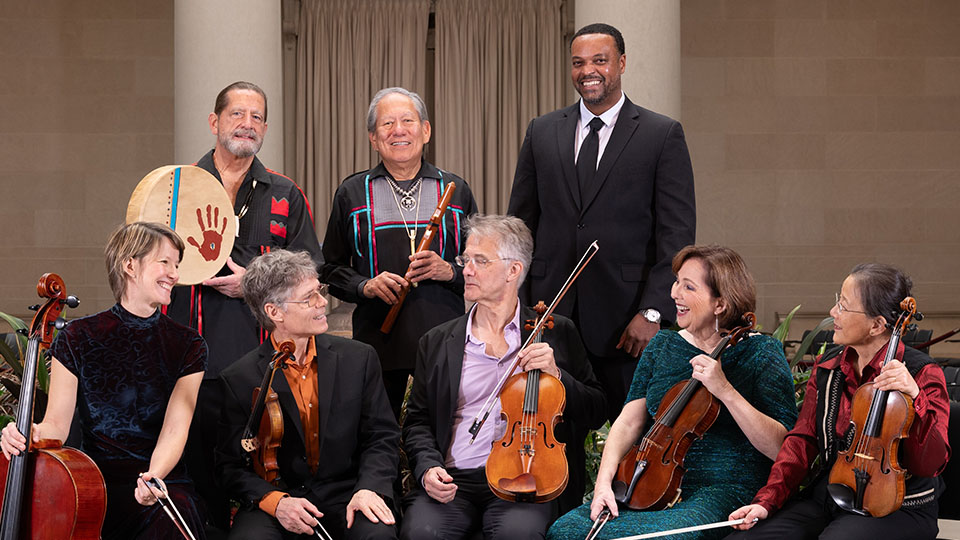
'Cultural Crossroads: Dvořák in America'
7:30 p.m. Saturday, February 6, 2027 | Polsky Theatre
Tickets start at $25.
Individual Tickets Season Tickets (save 15-20% per show)
Pre-show lecture with Dr. Paul Laird at 6:30 p.m.
"Cultural Crossroads: Dvořák in America" is a live concert experience that explores the Black and Indigenous influences on Dvořák during his time in America. The program weaves original Native American melodies and moving African American Spirituals, along with Dvořák’s most beloved chamber music.
Short videos and imagery add to this powerful multimedia experience. “Cultural Crossroads: Dvořák in America,” with its stellar and diverse cast of musicians, is a catalyst for audience engagement as it entertains, educates, and inspires, drawn from the curiosity of a Czech composer a century ago.
Program will include:
- Quartet, no 12 in F Major, op. 96, “American” by Antonín Dvořák
- Butterflies Dancing by R. Carlos Nakai
- Swing Low, Sweet Chariot Spiritual, folk song (arranged Burleigh/Grafilo)
- Quintet, no. 3 in E-flat Major, op. 97, “American” by Antonín Dvořák
- My Lord, What a Morning Spiritual, folk song (arranged Burleigh/Grafilo)
- Clan of the Mists by R. Carlos Nakai
- Quintet, no. 3 in E-flat Major, op. 97, “American” by Antonín Dvořák
- Go Down Moses Spiritual, folk song
- By and By Spiritual, folk song (arranged Burleigh/Grafilo)
- Honoring Song by R. Carlos Nakai
- Amazing Grace by John Newton
- Quintet, no. 3 in E-flat Major, op. 97, “American” (excerpt) by Antonín Dvořák
- Quintet, no. 3 in E-flat Major, op. 97, “American” by Antonín Dvořák
- Going Home by Dvořák/Fisher/Grafilo
Robert Sims, Baritone
Robert Sims is an acclaimed lyric baritone renowned for his rich, resonant voice and captivating stage presence. Recognized internationally for his artistry, Sims has earned particular praise for his interpretations of African American spirituals and concert repertoire. He has graced prestigious venues such as Carnegie Hall, Lincoln Center, the Kennedy Center, and major concert halls across Europe, Asia, and North America. Sims has collaborated with prominent orchestras and conductors, as well as a variety of chamber ensembles, always bringing a distinctive warmth and clarity to his performances. Of special note is his ongoing project The Majesty of the Spiritual which he performs in conjunction with some of the most celebrated black vocalists of our time. In addition to his solo work, Sims is an ardent promoter of American song and the spiritual tradition, frequently appearing in recitals and educational programs that celebrate this vital musical heritage. His commitment to outreach and mentorship has inspired emerging artists and fostered a greater appreciation for this repertoire worldwide. A graduate of Oberlin Conservatory, Northwestern University, and SUNY Binghamton, Sims boasts a diverse musical education that underpins his versatile career.
Carlos Nakai, Native Flutist
Of Navajo-Ute heritage, R. Carlos Nakai is the world’s premier performer of the Native American flute. He began his musical studies on the trumpet, but a car accident ruined his embouchure. His musical interests took a turn when he was given a traditional cedar flute as a gift and challenged to master it. As an artist, he is an adventurer and risk-taker, always giving his musical imagination free rein.
Nakai is also an iconoclastic traditionalist who views his cultural heritage not only as a source and inspiration, but also a dynamic continuum of natural change, growth, and adaptation subject to the artist’s expressive needs. Nakai’s first album, “Changes,” was released by Canyon Records in 1983, and since then, he has released 40 albums with Canyon plus additional albums and guest appearances on other labels.
In addition to his educational workshops and residencies, Nakai has appeared as a soloist throughout the United States, Europe, and Japan, and has worked with guitarist/luthier William Eaton, composer James DeMars, pianist Peter Kater and the late Paul Horn, among many others. The famed American choreographer Martha Graham used Nakai’s second album, “Cycles,” in her last work, “Night Chant.” Nakai contributed music to the major motion pictures “New World” (New Line) and “Geronimo” (Columbia).
Nakai, while cognizant of the traditional use of the flute as a solo instrument, began finding new settings for it, especially in the genres of jazz and classical. He founded the ethnic jazz ensemble, the R. Carlos Nakai Quartet, to explore the intersection of ethnic and jazz idioms. Nakai brought the flute into the concert hall, performing with over 30 symphony and chamber orchestras. He was a featured soloist on the Philip Glass composition “Piano Concerto No. 2: After Lewis & Clark,” premiered by the Omaha Symphony. Nakai also works with producer and arranger Billy Williams, a two-time Grammy winner, in composing for and performing the traditional flute in orchestral works of a lighter vein.
In a crosscultural foray, Nakai performed extensively with the Wind Travelin’ Band, a traditional Japanese ensemble from Kyoto which resulted in an album, “Island of Bows.” Additional recordings with ethnic artists include “In A Distant Place” with Tibetan flutist and chanter Nawang Khechog, and “Our Beloved Land” with famed Hawaiian slack key guitarist and singer Keola Beamer.
Recently, Nakai released “Voyagers” with Philadelphia Orchestra cellist Udi Bar-David, which blends Native American melodies with Jewish and Arabic songs. Nakai has received two gold records (500,000 units sold) for “Canyon Trilogy” and “Earth Spirit,” which are the first (and only) Native American recordings to earn this recognition. In 2014, “Canyon Trilogy” reached Platinum (over 1 million units sold), the first ever for a Native American artist performing traditional solo flute music. He has sold over 4 million albums in the course of his career. His Grammy nominations include:
- Ancestral Voices (1994 Best Traditional Folk Album)
- Inner Voices (2000 Best New Age Album)
- Inside Monument Valley (2000 Best New Age Album)
- In A Distant Place (2001 Best New Age Album)
- Fourth World (2002 Best New Age Album)
- Sanctuary (2003 Best Native American Album)
- People of Peace (2005 Best New Age Album)
- Reconnections (2008 Best Native American Album)
- Dancing Into Silence (2009 Best New Age Album)
- Awakening the Fire (2013 Best New Age Album)
A Navy veteran, Nakai earned a master’s degree in American Indian Studies from the University of Arizona. He was awarded the Arizona Governor’s Arts Award in 1992, and an honorary doctorate from Northern Arizona University in 1994. In 2005, Nakai was inducted into the Arizona Music & Entertainment Hall of Fame. Nakai has also authored a book with composer James DeMars, “The Art of the Native American Flute,” which is a guide to performing the traditional cedar flute.
Will Clipman, World Percussionist
Will Clipman began playing his father’s drums and his mother’s piano at the age of 3. He played his first professional gig at 14 and since then, has mastered a pan-global palette of ethnic drums and percussion instruments, in addition to the traditional drum set. Clipman is a seven-time Grammy nominee, a three-time Native American Music Award Winner, a Canadian Aboriginal Music Award Winner, a New Age Reporter Music Award Winner, a Zone Music Reporter Award Winner, and a two-time TAMMIE Award Winner, and has been inducted into the Tucson Musicians Museum for his contributions to the musical community in his hometown.
Clipman has recorded over 70 albums, including 37 for Canyon Records, the world’s foremost Native American music label. In addition to his solo work, Clipman has performed and recorded with renowned Native American flute master R. Carlos Nakai for 30 years and works with many other internationally acclaimed artists and ensembles. Clipman’s solo album “Pathfinder” earned a Grammy nomination for Best New Age Album, and his “Planet of Percussion” performance and workshop takes audiences of all ages on a world tour of rhythm and polyrhythm.
A poet since the age of 6, Clipman has published a book of his original poetry entitled “Dog Light” (Wesleyan University Press), and his work has appeared widely in magazines and anthologies, including the St. Martin’s Press anthology “Dog Music,” the University of Nevada Press anthology “TumbleWords: Writers Reading the West,” and the Southern Poetry Review anthology “Looking West.” His writing has been honored with the Whiffen Poetry Prize, the Academy of American Poets Margaret Sterling Award, the Tucson/Pima Arts Council Poetry Fellowship, and the Arizona Commission on the Arts Award of Merit for Poetry. His poem “The Quiet Power” is the official Dedicatory Poem of the Tucson Main Library.
Clipman is also an accomplished mask maker and storyteller. His “Myths & Masks” performance and workshop combines his original mask art, mythopoetic storytelling and multicultural world music, and is available as a DVD. In his 40-year career as an arts educator, Clipman has conducted hundreds of workshops, lecture-demonstrations, master classes, full-length artist-in-residencies and self-realization events for elementary, middle and high schools, colleges and universities, art galleries, libraries, adult prisons, juvenile detention facilities, adult assisted living communities, hospitals, parks and recreation programs, retreat centers, spas and resorts. His service as an arts educator has been honored with the Arizona Commission on the Arts Decade of Distinguished Service Award and three Arizona Governor’s Arts Award Nominations.
Clipman holds a Bachelor of Arts degree from Syracuse University and a Master of Fine Arts degree from the University of Arizona.
The Ciompi Quartet
Since its founding in 1965 by the renowned Italian violinist Giorgio Ciompi, the Ciompi Quartet of Duke University has delighted audiences and impressed critics around the world. In a career that spans five continents and includes many hundreds of concerts, the Ciompi Quartet has developed a reputation for performances of real intelligence and musical sophistication, with a warm, unified sound that allows each player’s individual voice to emerge.
In recent years, the Ciompi Quartet has performed across the U.S. from Washington State to California, Texas, New York, Washington, D.C. and New England, and abroad from China and Taiwan to France, Italy, Germany, Austria, the Czech Republic, Serbia and Albania. In June 2024, the Quartet performed in Vienna at a celebration of that composer’s 150th anniversary sponsored by the Arnold Schoenberg Center. The Quartet has performed at the Great Lakes Chamber Music Festival in Detroit, North Carolina’s Eastern Music Festival and Highlands Chamber Music Festival, and at Monadnock Music in New Hampshire.
The Ciompi Quartet’s commitment to creative programming often mixes the old and the new in exciting ways. Most recently, the quartet engaged composers Alan Chan and Andrew Waggoner to write new works for string quartet and pipa, in a collaboration with pipa player Min Xiao-Fen called “An American in Shanghai: Forgotten Stories.” Its extensive catalog of commissions includes many that the group continues to perform on tour. Close ties to composers such as Paul Schoenfield, Stephen Jaffe, Scott Lindroth, and Melinda Wagner have produced important contributions to the repertoire; the quartet recently premiered Stephen Jaffe’s Third String Quartet and two new quintets by Lindroth: “Schley Road” for quartet and saxophone, and his Cello Quintet.
Other recent recordings are on “Toccata Classics” (a quartet by 19th century violin virtuoso Heinrich Ernst), and Naxos, which released “Journey to the West” by Chiayu Hsu. Also on Naxos online is a recording of the quartets of Paul Schoenfield, including the popular “Tales from Chelm.” Numerous other discs are on the CRI, Arabesque, Albany, Gasparo, and Sheffield Lab labels. All the Ciompi Quartet members are professors at Duke University, where they lead the string studios and chamber music program and perform across campus in traditional and nontraditional venues. Members of the Ciompi are violinists Eric Pritchard and Hsiao-Mei Ku, violist Jonathan Bagg, and cellist Caroline Stinson.
Pamela Freund-Striplen, Curator/Narrator/Violist
Pamela Freund-Striplen served as Artistic Director and violist of the Gold Coast Chamber Players based in the San Francisco Bay Area for 35 years. As such, she developed over 150 unique concert programs and three educational outreach programs. At the final Gold Coast Chamber Players performance, the local mayor proclaimed that day as Pamela Freund-Striplen Day for her community contributions. Motivated by the social impact of her special projects like “Cultural Crossroads: Dvořák in America,” Freund-Striplen is now focusing on taking these programs to national and international audiences.
A passionate chamber musician, Freund-Striplen has collaborated with leading chamber musicians throughout the world. She has performed with members of the St. Lawrence, Alexander, Escher and Verona String Quartets and has been a frequent guest artist with the Amati Ensemble, performing in the Netherlands and Germany. Performances with the Amati Ensemble have included chamber music concerts for “Berlin Enescu Days'' and a concert tour of all the Mozart viola quintets.
She performed in Vienna, Strasbourg, and throughout Germany with the New European Strings under the direction of Dmitry Sitkovetsky, and later performed with the ensemble at the Seattle International Music Festival. She has performed with San Diego Symphony and as Principal Violist with San Diego Opera and San Francisco Opera’s touring arm, Western Opera Theater. She performed regularly with San Francisco Opera Orchestra, the San Francisco Symphony, and on the San Francisco Symphony chamber music series, Chamber Music Sundaes.
Having attended Pomona College and Oberlin Conservatory of Music, Freund-Striplen continued her studies with the Curtis Quartet in Philadelphia, where she received the Young Musician’s Award in chamber music for two consecutive years. Her late viola teacher, Max Aronoff, continues to be a great source of inspiration to her.
Freund-Striplen maintained a private teaching studio for over 30 years and was a violin/viola instructor at Occidental College and Saint Mary’s College of California. She was a chamber music coach at the San Francisco Conservatory of Music pre-college for eight years.